


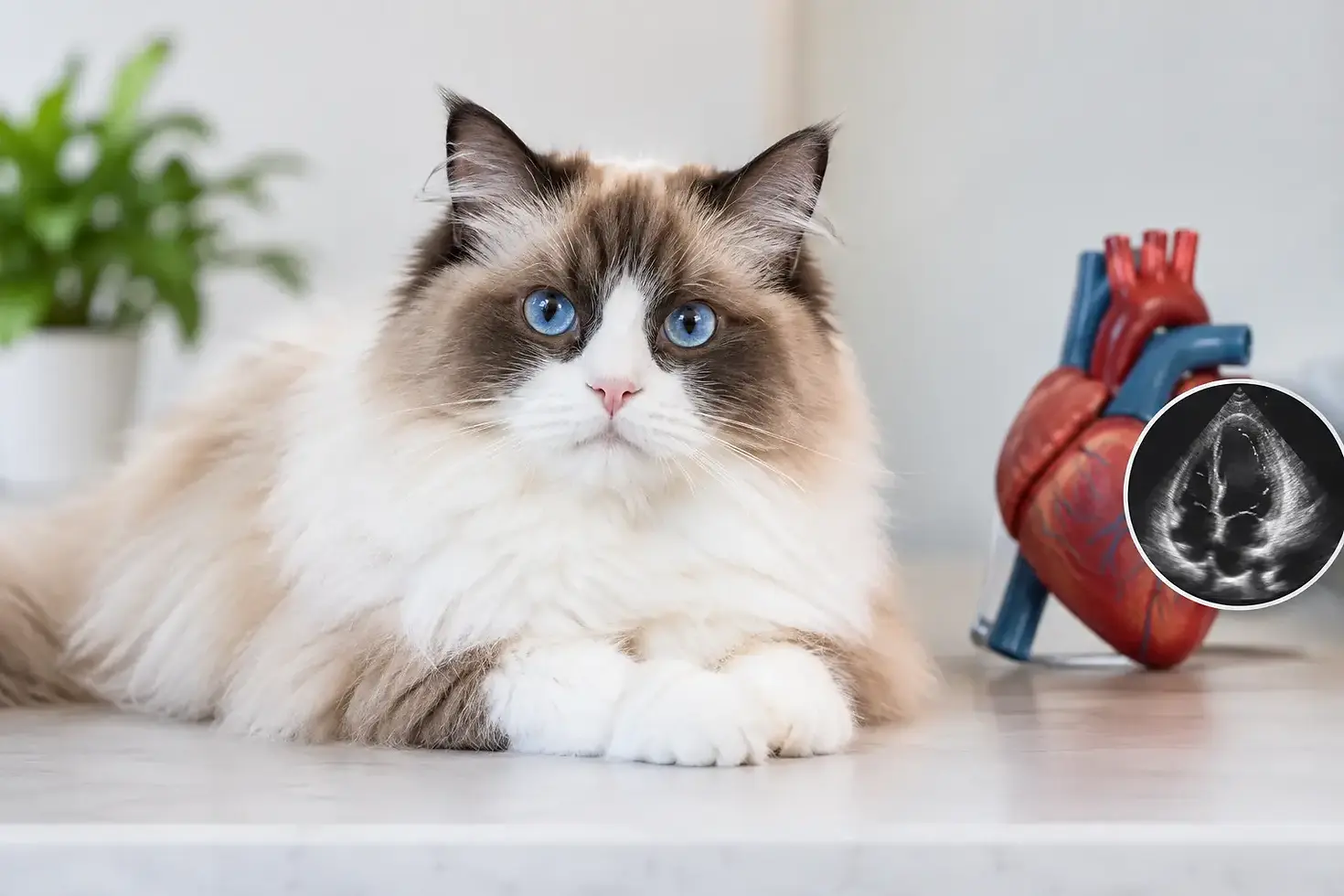
HCM Negative Parent Example for Ragdoll Buyers
When a breeder says a Ragdoll kitten comes from HCM negative parents, that statement should give you a starting point for a thoughtful conversation, not simply a phrase to check off. An HCM negative parent example helps prospective kitten families understand what health documentation may look like, what the result can and cannot tell us, and why responsible breeding involves more than one piece of paper.
For families hoping to welcome a gentle, affectionate Ragdoll into their home, asking about HCM testing is a wise and caring step. The best breeders are comfortable discussing their breeding cats, their testing practices, and the limits of genetic health screening with honesty.
What Does HCM Negative Mean in Ragdolls?
HCM stands for hypertrophic cardiomyopathy, a disease in which the heart muscle becomes abnormally thick. As the heart walls thicken, the heart may have more difficulty filling and pumping blood effectively. HCM can occur in cats of any breed, including mixed-breed cats, but it has received particular attention in Ragdolls because a known genetic variant has been identified in some Ragdoll lines.
A DNA test can screen for the Ragdoll-associated variant in the MYBPC3 gene. When a breeding cat receives a negative result for that tested variant, it means the laboratory did not detect that specific mutation in the cat's DNA sample.
That is meaningful information. It can help breeders make informed pairing decisions and reduce the risk of passing on the known Ragdoll-associated variant. Still, a negative genetic result is not the same as a lifetime guarantee that a cat will never develop heart disease. HCM is a complex condition, and not every cause of HCM in cats is explained by the single genetic variant available on a DNA panel.
An HCM Negative Parent Example, Explained
Imagine a breeder shares the following information about a kitten's parents:
Queen: Daisy Ragdoll HCM genetic test: N/N (negative/negative) Laboratory result: No copies of the tested Ragdoll-associated MYBPC3 variant detected
Sire: Oliver Ragdoll HCM genetic test: N/N (negative/negative) Laboratory result: No copies of the tested Ragdoll-associated MYBPC3 variant detected
In this HCM negative parent example, both Daisy and Oliver tested negative for the specific Ragdoll HCM mutation included in the DNA test. Because neither parent carries that tested variant, their kittens would not inherit that particular mutation from them.
The notation matters. A report may use terms such as N/N, clear, or negative, depending on the laboratory. A responsible breeder should be able to explain the wording and provide documentation that identifies the cat tested, the laboratory, the date, and the specific condition screened.
A result showing one copy of a variant is often described as heterozygous or N/variant. Two copies may be described as homozygous or variant/variant. Those results require careful veterinary and breeding guidance. They should never be brushed aside with vague reassurance.
Why a Negative Result Is Valuable but Not a Promise
Health testing is about making responsible decisions with the information available. It is not about claiming that living animals can come with absolute certainty.
The Ragdoll DNA test looks for a known mutation. A negative result means that known mutation was not found, but it does not screen for every possible genetic change that could influence heart health. It also cannot predict every health event a cat may experience over a lifetime.
For this reason, a breeder who says, "Our cats are HCM negative," should be willing to clarify what they mean. Do they mean the parents had negative DNA results for the known Ragdoll variant? Were the cats also evaluated by a veterinarian? Are they monitoring their breeding program as cats mature? Clear answers show care and accountability.
There is a trade-off in how buyers interpret testing. It would be unwise to dismiss DNA screening as unhelpful because it is not a complete guarantee. It would also be unwise to treat one negative result as proof that no cardiac concern could ever arise. The balanced view is that appropriate testing is an essential part of responsible breeding, alongside thoughtful pedigrees, veterinary care, observation, and a commitment to make careful choices over time.
What Responsible HCM Communication Looks Like
A trustworthy breeder does not rely on medical-sounding language alone. They explain their program in a way that helps families make informed decisions.
First, they can identify which cat was tested. Test results should correspond to the breeding queen or sire, not simply to an unnamed claim on a website or social media post. A report may include the cat's registered name, microchip number, date of birth, or another identifying detail.
Second, they can explain which test was performed. Ask whether the result is a DNA test for the Ragdoll-associated HCM variant, a heart ultrasound performed by a veterinary cardiologist, or both. These are different tools. DNA testing identifies the tested genetic variant; echocardiography evaluates the heart's structure at a point in time. Depending on a breeder's program, age of their cats, family history, and veterinary guidance, they may use one or both approaches.
Third, they speak plainly about limitations. Honest breeders do not promise that a kitten is immune to all illness. Instead, they explain the preventive steps they take and stand behind the standards they use when selecting breeding cats.
Finally, they keep the kitten's whole well-being in view. HCM testing matters deeply, but it is one part of responsible care. Families should also ask about testing for FeLV/FIV and PKD, routine veterinary care, sanitation, nutrition, temperament, early socialization, registration, and the breeder's contract.
Questions to Ask Before Reserving a Ragdoll Kitten
A kind, reputable breeder will welcome reasonable questions. You do not need to be a veterinary professional to ask for clarity. Start with simple, direct language: “May I see the HCM test results for both parents?” and “Which HCM test was used?”
It is also helpful to ask when the tests were completed and whether the breeder has any known heart-health concerns in the immediate family lines. If a breeder uses echocardiograms, ask who performed the evaluation and when. An ultrasound completed years earlier may still be useful history, but it does not describe a cat's current cardiac status in the same way as a more recent examination.
Pay attention to the quality of the conversation, not just the answer. A breeder may need a little time to retrieve records, particularly if they are caring for kittens and cats at home. That is very different from refusing to discuss testing, offering only a blurry screenshot without identifying information, or making sweeping health guarantees with no explanation.
For first-time Ragdoll owners, it can help to remember that a good breeder is choosing a home as carefully as you are choosing a breeder. The relationship should feel respectful, transparent, and centered on the long-term welfare of the cats.
Looking Beyond the Test Result
The goal of health testing is not to create fear. It is to help breeders reduce avoidable risk and help families choose with greater confidence.
At Hill Raising Ragdolls, we believe prospective families deserve straightforward information about the care behind each kitten. A well-raised Ragdoll should come from a program that values health screening, careful observation, loving socialization, and responsible decisions over quick promises.
If you see an HCM negative parent result, let it be the beginning of your questions. Ask what was tested, review the parent information, and look for a breeder who can speak with both confidence and humility. That combination is often a meaningful sign that your future kitten has been cared for with the attention every family hopes to find.


Comments